
How the EU Is Regulating Sustainable Investing

How the EU Is Regulating Sustainable Investing

Arun Kelshiker

20 years: Asset management and stewardship

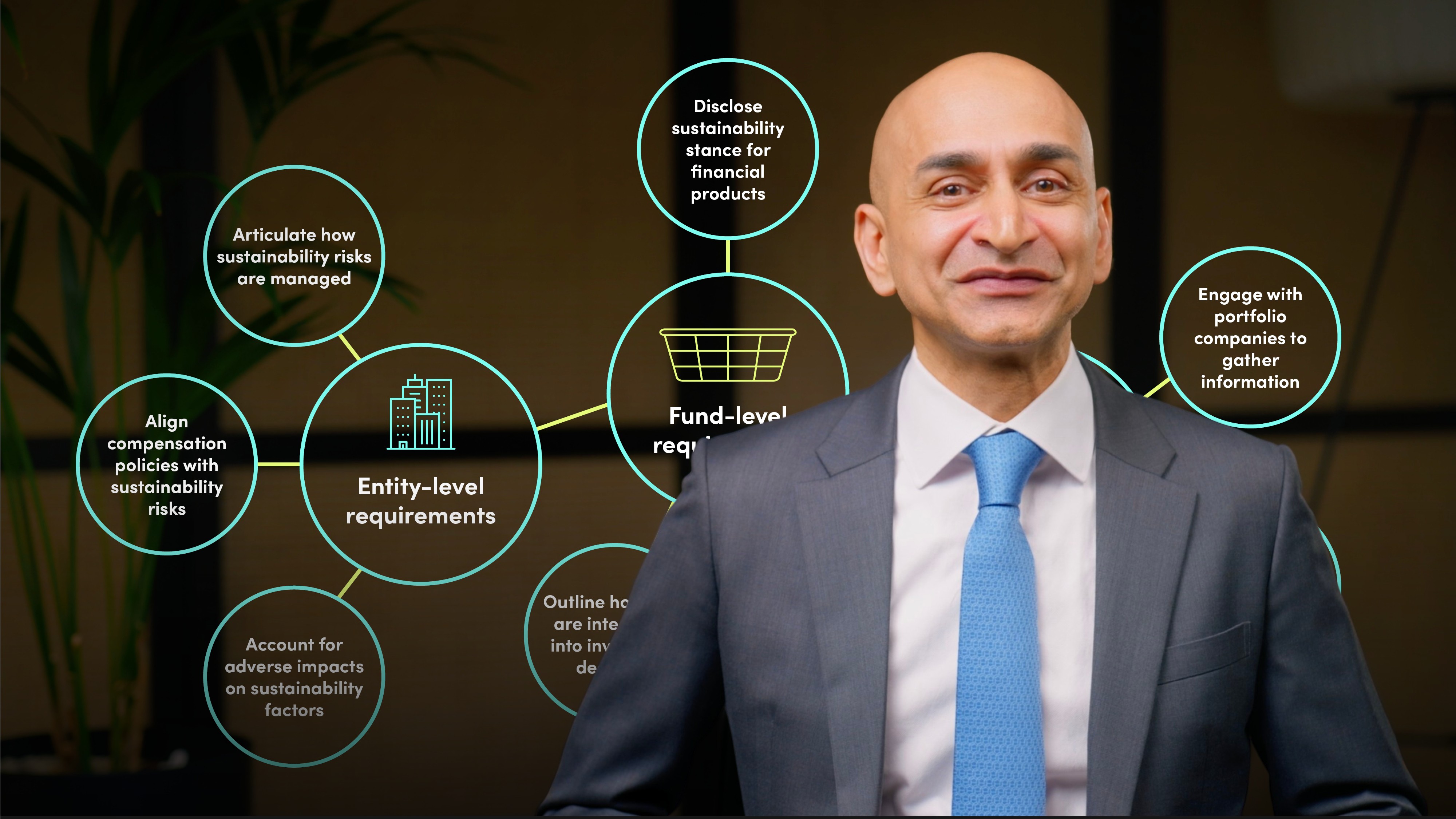
In this video, Arun breaks down the EU’s Sustainable Finance Disclosure Regulation (SFDR) and explains how it promotes transparency and accountability in sustainable investing. He explores how the SFDR works alongside the EU Taxonomy to define what counts as environmentally sustainable, and walks through the key differences between Articles 6, 8, and 9 financial products. He also sheds light on how the regulation combats greenwashing by requiring financial institutions to disclose sustainability risks and impacts at multiple levels.

In this video, Arun breaks down the EU’s Sustainable Finance Disclosure Regulation (SFDR) and explains how it promotes transparency and accountability in sustainable investing. He explores how the SFDR works alongside the EU Taxonomy to define what counts as environmentally sustainable, and walks through the key differences between Articles 6, 8, and 9 financial products. He also sheds light on how the regulation combats greenwashing by requiring financial institutions to disclose sustainability risks and impacts at multiple levels.

Speak to an expert

Speak to an expert today to access this and all of the content on our platform.

How the EU Is Regulating Sustainable Investing

9 mins 27 secs

Key learning objectives:

  • Understand the purpose and scope of the Sustainable Finance Disclosure Regulation (SFDR)

  • Outline the role of the EU Taxonomy in defining environmentally sustainable economic activities

  • Identify the categories of financial products under SFDR and their corresponding disclosure requirements

  • Understand how SFDR addresses greenwashing and promotes transparency in sustainable investing

Overview:

The EU's Sustainable Finance Disclosure Regulation (SFDR) promotes transparency and accountability in sustainable investing by mandating financial market participants to disclose their integration of sustainability risks and impacts. SFDR requires disclosures at the entity, fund, and portfolio levels, categorising products into three types: Article 6 (non-ESG), Article 8 (light green), and Article 9 (dark green). It complements the EU Taxonomy, which classifies environmentally sustainable economic activities. By providing detailed pre- and post-investment disclosures, SFDR empowers investors to make informed, responsible decisions, addressing risks like greenwashing and aligning financial markets with sustainability goals set by the European Green Deal.

Speak to an expert

Speak to an expert today to access this and all of the content on our platform.

Summary
What is the Sustainable Finance Disclosure Regulation (SFDR), and why was it introduced?

The SFDR is a groundbreaking EU regulation designed to enhance transparency and accountability in sustainable investing. It requires financial market participants and advisers to disclose how they integrate sustainability risks and consider the environmental and social impacts of their investments. Introduced to combat greenwashing, SFDR ensures that sustainability claims are credible and verifiable, protecting investors and aligning the financial sector with broader EU goals like the European Green Deal. By setting standardised disclosure requirements, SFDR empowers investors to make informed decisions and fosters trust in the burgeoning field of sustainable finance.

How does the EU Taxonomy support SFDR in defining sustainable investments?

The EU Taxonomy provides a clear classification system for determining whether an economic activity is environmentally sustainable. It evaluates activities based on six objectives, including climate change mitigation and biodiversity protection, while requiring adherence to principles like “Do No Significant Harm.” This framework supports SFDR by offering a common language for sustainability, enabling consistent reporting and reducing ambiguity. For instance, it helps distinguish sustainable activities within funds categorised under Articles 8 and 9, reinforcing the credibility of disclosed information.

What are Article 6, Article 8, and Article 9 funds, and how do they differ?

SFDR divides financial products into three categories:
  • Article 6 funds are general investment products that do not integrate sustainability considerations, allowing investments in industries like tobacco or coal
  • Article 8 funds (light green) promote environmental or social attributes but may not explicitly target sustainable outcomes
  • Article 9 funds (dark green) focus solely on sustainable investments with a clearly defined objective, such as renewable energy

How does SFDR help prevent greenwashing in financial markets?

SFDR addresses greenwashing by mandating detailed disclosures at multiple levels. Firms must provide entity-level information on how sustainability risks are managed, fund-level data on adherence to principles like "Do No Significant Harm," and portfolio-level engagement with invested companies. Additionally, Articles 8 and 9 require both pre-investment and post-investment disclosures, covering ESG metrics and alignment with the EU Taxonomy. This rigorous framework deters misleading claims and ensures that sustainability is embedded in financial decision-making, holding firms accountable and protecting investors from deceptive practices.

Speak to an expert

Speak to an expert today to access this and all of the content on our platform.

Arun Kelshiker

Arun Kelshiker

Arun Kelshiker was formerly the Head of Asset Allocation and Portfolio Strategy at Standard Chartered Bank and part of the bank's Global Investment Committee, where he provided investment advisory and multi-asset portfolio solutions. His focus is now with Cambridge Sustainable Investment Partners, which draws its expertise from the Resilience and Sustainable Development Centre at Cambridge University. He is also a university lecturer at the Frankfurt School of Finance and Management and is Vice Chair of the CFA UK's Inclusion and Diversity Committee and its Investment Committee.

There are no available Videos from "Arun Kelshiker"